

South Korea Electronic Toll Collection Market Expands with Smart Transport; Kapsch, Siemens, Thales Lead
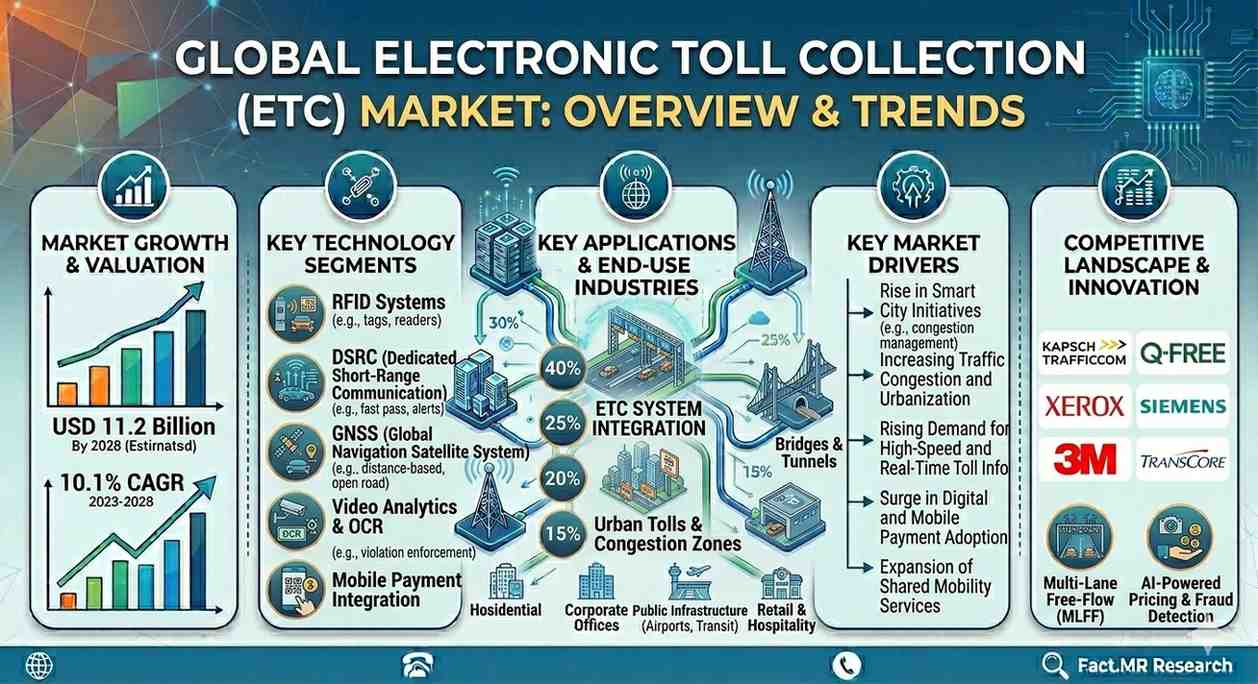
Electronic Toll Collection
Government-led highway modernization, RFID adoption, and cashless mobility systems drive South Korea’s shift toward fully automated tolling infrastructure
ROCKVILLE, MD, UNITED STATES, April 10, 2026 /EINPresswire.com/ -- According to Fact.MR’s latest analysis, the South Korea electronic toll collection (ETC) market is witnessing steady growth driven by smart transport initiatives and modernization of highway infrastructure. The global ETC market is valued at USD 16.9 billion in 2026, expected to reach USD 18.7 billion in 2027, and projected to expand to USD 46.3 billion by 2036. South Korea’s demand is forecast to grow at 7.6% CAGR through 2036, supported by deployment of RFID-enabled tolling systems and increasing emphasis on cashless mobility.The market transformation is fueled by a transition from manual toll collection to automated, interoperable payment systems that reduce congestion and improve operational efficiency. Government-backed smart transport initiatives and digital payment adoption are reshaping tolling infrastructure across highways, bridges, and urban roads.
Get detailed market forecasts, competitive benchmarking, and pricing trends:
https://www.factmr.com/connectus/sample?flag=S&rep_id=14513
Quick Stats – South Korea Electronic Toll Collection Market
Market Size (2026): USD 16.9 billion (global benchmark)
Market Size (2027): USD 18.7 billion (estimated)
Forecast Value (2036): USD 46.3 billion
South Korea CAGR (2026–2036): 7.6%
Incremental Opportunity: Expansion of RFID-based tolling infrastructure and smart highways
Leading Technology Segment: RFID (35.5% share)
Leading Product Type: Transponders (23.2% share)
Leading Country Focus: South Korea
Key Players: Kapsch TrafficCom, Siemens Mobility, Thales Group, Conduent, Cubic Corporation
Executive Insight for Decision Makers
South Korea’s ETC market is evolving toward fully automated, interoperable tolling ecosystems integrated with smart mobility platforms.
Strategic Shift
Migration from manual toll booths to cashless tolling
Deployment of RFID and ANPR-based systems
Integration with national smart transport initiatives
What OEMs / Investors Must Do
Invest in interoperable RFID and DSRC technologies
Provide scalable cloud-based tolling platforms
Focus on predictive traffic analytics and congestion management
Risks of Not Adapting
Exclusion from government infrastructure tenders
Reduced competitiveness in smart transport projects
Limited participation in long-term maintenance contracts
Market Dynamics
Key Growth Drivers
Government highway modernization programs
Adoption of RFID-based tolling systems
Increasing traffic congestion management initiatives
Growing demand for cashless digital payment infrastructure
Key Restraints
High installation costs for toll infrastructure
Integration complexity with legacy systems
Data security and interoperability challenges
Emerging Trends
Account-based tolling platforms
Multi-lane free-flow tolling systems
GNSS-based distance tolling models
AI-driven traffic analytics integration
Segment Analysis
Leading Segment
RFID technology holds 35.5% share, driven by high-speed vehicle identification and seamless toll processing.
Fastest Growing Segment
GNSS-based and video analytics tolling solutions are expanding as smart mobility adoption increases.
By Product Type
Transponders – 23.2% share
Antennae and communication systems
Inductive loops and sensors
Video analytics hardware
Strategic Importance
Transponders remain critical for automatic vehicle identification and interoperability across toll networks.
Supply Chain Analysis
Raw Material Suppliers
Semiconductor manufacturers
RFID chip producers
Sensor and communication module suppliers
Manufacturers / Producers
Toll system equipment manufacturers
ITS (Intelligent Transportation System) providers
Mobility technology integrators
Distributors
Infrastructure engineering contractors
Government procurement agencies
Smart transport integrators
End Users
Highway authorities
Urban transport departments
Bridge and tunnel operators
Infrastructure concessionaires
Who Supplies Whom
Chip and sensor suppliers provide components to ETC system manufacturers. These manufacturers integrate RFID readers, transponders, and communication systems into tolling infrastructure. Systems are delivered through infrastructure contractors to government agencies and toll operators, who deploy and manage toll collection networks.
Pricing Trends
Commodity vs Premium
Basic RFID-based systems priced competitively
Advanced multi-lane free-flow tolling commands premium pricing
Key Influencing Factors
Hardware component costs
Software integration complexity
Interoperability requirements
Maintenance and service contracts
Margin Insights
Hardware margins remain moderate
Software and analytics solutions deliver higher profitability
Long-term service agreements enhance recurring revenue
Regional Analysis
Top 5 Countries by CAGR
China – 10.0%
South Korea – 7.6%
United Kingdom – 7.4%
United States – 6.6%
Germany – 6.0%
Why South Korea is Growing
Smart transport infrastructure investments
Expansion of highway networks
Cashless payment adoption
Government automation initiatives
Developed vs Emerging Markets
South Korea growth driven by technology upgrades
Emerging markets driven by new toll road construction
Mature markets emphasize interoperability and efficiency
Competitive Landscape
The South Korea ETC market is moderately concentrated, with global infrastructure providers competing for government contracts.
Key Players
Kapsch TrafficCom
Siemens Mobility
Thales Group
Conduent Incorporated
Cubic Corporation
TransCore
Egis Group
Neology Inc.
Raytheon Technologies
Verra Mobility
Competitive Strategies
Interoperable tolling solutions
High-reliability system deployment
Long-term maintenance contracts
Smart mobility platform integration
Strategic Takeaways
For Manufacturers
Focus on RFID and GNSS-based solutions
Offer scalable multi-lane tolling systems
Invest in predictive analytics capabilities
For Investors
Target smart transport infrastructure providers
Monitor government mobility projects
Invest in tolling software platforms
For Marketers / Distributors
Emphasize congestion reduction benefits
Target highway modernization programs
Position solutions as smart city enablers
Future Outlook
South Korea’s ETC market is expected to transition toward:
Fully cashless toll highways
Multi-lane free-flow tolling
Integrated mobility platforms
AI-based traffic optimization
Technology innovation and smart city initiatives will continue to expand market opportunities.
Conclusion
South Korea’s electronic toll collection market is advancing toward intelligent, automated tolling infrastructure. With strong government support and rising demand for seamless mobility, the market presents substantial opportunities for technology providers and infrastructure investors. The shift to interoperable, digital tolling systems will define long-term growth.
Why This Market Matters
Electronic toll collection is becoming a cornerstone of South Korea’s smart transport ecosystem. By improving traffic flow, reducing congestion, and enabling cashless payments, ETC solutions are transforming mobility infrastructure and creating sustainable growth opportunities for stakeholders.
Full Report: Unlock 360° insights for strategic decision making and investment planning-
https://www.factmr.com/checkout/14513
To View Related Report:
Electronic Cartography Market https://www.factmr.com/report/electronic-cartography-market
Electronic Speed Controller (ESC) for Drones and UAVs Market https://www.factmr.com/report/electronic-speed-controller-esc-for-drones-and-uavs-market
Electronic Design Automation Market https://www.factmr.com/report/electronic-design-automation-market
Electronic Design Automation Software Market https://www.factmr.com/report/electronic-design-automation-eda-tools-market
S. N. Jha
Fact.MR
+1 628-251-1583
email us here
Legal Disclaimer:
EIN Presswire provides this news content "as is" without warranty of any kind. We do not accept any responsibility or liability for the accuracy, content, images, videos, licenses, completeness, legality, or reliability of the information contained in this article. If you have any complaints or copyright issues related to this article, kindly contact the author above.
