

Global Sulfur Fertilizer Market Led by North America; Yara, Nutrien, Mosaic Strengthen Crop Nutrition
Sulfur Fertilizer
Sulfur Fertilizer Market is segmented by Type (Elemental Sulfur, Sulfate Fertilizers, and Sulfur-coated Urea & Specialty)
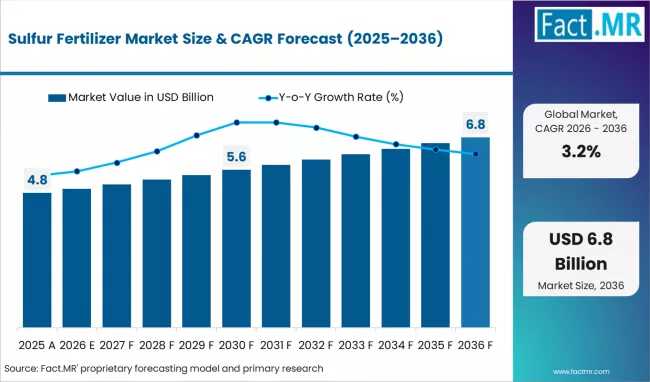
ROCKVILLE, MD, UNITED STATES, April 9, 2026 /EINPresswire.com/ -- According to Fact.MR’s latest analysis, the global sulfur fertilizer market is transitioning from reactive nutrient correction to programmatic crop nutrition planning. The market was valued at USD 4.80 billion in 2025, is projected to reach USD 4.95 billion in 2026, and is forecast to expand to USD 6.79 billion by 2036, registering a CAGR of 3.2%.The industry is expected to generate an incremental opportunity of USD 1.83 billion during the forecast period. Declining atmospheric sulfur deposition, increasing soil nutrient depletion, and precision agriculture adoption are compelling growers to integrate sulfur into baseline fertilization strategies rather than treating it as a secondary corrective input.
Get detailed market forecasts, competitive benchmarking, and pricing trends:
https://www.factmr.com/connectus/sample?flag=S&rep_id=5860
Quick Stats
Market Size (2026): USD 4.95 Billion
Market Size (2027): USD 5.11 Billion (est.)
Forecast Value (2036): USD 6.79 Billion
CAGR (2026–2036): 3.2%
Incremental Opportunity: USD 1.83 Billion
Leading Segment: Elemental Sulfur (45% share)
Leading Region: North America
Key Players: Yara International ASA, Nutrien Ltd., The Mosaic Company, EuroChem Group, ICL Group
Executive Insight for Decision Makers
The sulfur fertilizer market is shifting from optional micronutrient supplementation to mandatory nutrient budgeting.
Strategic Shift
Sulfur integrated into seasonal nutrient management plans
Precision agriculture platforms recommending sulfur dosage
Growing demand for controlled-release formulations
What Manufacturers and Investors Must Do
Expand coated and slow-release sulfur product portfolios
Integrate sulfur into multi-nutrient fertilizer blends
Strengthen agronomic advisory capabilities
Risks of Not Adapting
Fertilizer suppliers lacking controlled-release and precision-compatible sulfur products risk losing eligibility in variable-rate nutrient prescriptions.
Market Dynamics
Key Growth Drivers
Rising soil sulfur deficiency across major cropping regions
Adoption of precision agriculture and variable-rate application
Declining atmospheric sulfur deposition due to emission controls
Increasing demand for high-yield crop nutrition programs
Key Restraints
Volatility in sulfur raw material pricing
Logistics challenges in bulk fertilizer distribution
Competition from organic nutrient alternatives
Emerging Trends
Controlled-release sulfur formulations
Integration with nitrogen-phosphorus nutrient blends
Variable-rate sulfur application technology
Soil-testing-driven fertilizer recommendations
Segment Analysis
Leading Segment
Elemental sulfur accounts for 45% market share due to cost efficiency and long-term nutrient release.
Fastest Growing Segment
Controlled-release and coated sulfur fertilizers driven by precision farming.
Breakdown
By Type: Elemental Sulfur | Sulfate Fertilizers | Sulfur-Coated Urea & Specialty
By Application: Row Crops | Horticulture & Specialty Crops | Turf & Ornamentals
By Form: Solid/Granular | Liquid Solutions | Coated/Slow-Release
Strategic Importance
Row crops ensure volume demand, while coated and slow-release formulations provide premium pricing opportunities.
Supply Chain Analysis
Raw Material Suppliers
Sulfur producers from oil & gas refining
Mining-based elemental sulfur suppliers
Chemical intermediates providers
Manufacturers / Producers
Fertilizer manufacturers producing elemental and blended sulfur fertilizers
Controlled-release fertilizer producers
Multi-nutrient fertilizer compounders
Distributors
Agricultural input distributors
Cooperative supply chains
Retail farm input dealers
End Users
Row crop farmers (corn, soybean, canola)
Horticulture producers
Turf and ornamental managers
Agricultural service providers
Who Supplies Whom
Sulfur producers supply raw sulfur to fertilizer manufacturers. Manufacturers convert sulfur into elemental or blended fertilizers. Distributors deliver products through agricultural retail networks. Farmers purchase sulfur fertilizers for row crops and specialty crop nutrition programs.
Pricing Trends
Commodity pricing for bulk elemental sulfur fertilizers
Premium pricing for coated and controlled-release products
Pricing influenced by:
Raw sulfur cost
Crop demand cycles
Nutrient blending complexity
Precision agriculture compatibility
Margin Insight
Higher margins observed in specialty coated sulfur fertilizers and integrated nutrient blends.
Regional Analysis
Top Countries by CAGR
Mexico – 4.1%
United States – 3.9%
Germany – 3.3%
France – 3.0%
United Kingdom – 2.8%
Regional Growth Drivers
Mexico: Expanding horticulture export crops
USA: Row crop nutrient budgeting adoption
Germany: Precision agriculture leadership
France: Sustainable farming initiatives
UK: Soil nutrient management regulations
Developed vs Emerging Markets
Developed markets emphasize precision nutrient planning
Emerging markets drive volume through acreage expansion
Competitive Landscape
The sulfur fertilizer market is moderately fragmented with global fertilizer majors competing on distribution and formulation breadth.
Key Players
Yara International ASA
Nutrien Ltd.
The Mosaic Company
EuroChem Group AG
ICL Group Ltd.
OCI N.V.
Helm AG
Sinofert Holdings Limited
CF Industries Holdings Inc.
Saudi Basic Industries Corporation (SABIC)
Competitive Strategies
Precision-compatible fertilizer formulations
Distribution network expansion
Agronomic advisory services
Controlled-release technology investment
Strategic Takeaways
For Manufacturers
Expand coated sulfur product lines
Integrate sulfur into multi-nutrient fertilizers
For Investors
Focus on precision agriculture fertilizer technologies
Target emerging agricultural markets
For Marketers / Distributors
Promote soil-testing-driven sulfur programs
Strengthen agronomic consulting capabilities
Future Outlook
The sulfur fertilizer market is moving toward precision-driven nutrient management. Integration with smart farming platforms, controlled-release technologies, and sustainability initiatives will shape future growth.
Key opportunities include:
Variable-rate fertilizer application
Multi-nutrient sulfur blends
Sustainable crop nutrition programs
Digital agronomy platforms
Conclusion
The global sulfur fertilizer market is transitioning from supplemental application to essential nutrient planning. Companies investing in precision-compatible formulations, agronomic advisory services, and controlled-release technologies are positioned to capitalize on the USD 6.79 billion opportunity by 2036.
Why This Market Matters
Addresses widespread soil sulfur deficiency
Improves crop yield and nutrient efficiency
Supports precision agriculture adoption
Enhances sustainable farming practices
Full Report: Unlock 360° insights for strategic decision making and investment planning-
https://www.factmr.com/checkout/5860
To View Related Report:
Sulfur Hexafluoride Market https://www.factmr.com/report/sulfur-hexafluoride-market
Sulfur Guard Catalyst Market https://www.factmr.com/report/2509/sulfur-guard-catalyst-market
Low-Sulfur Fuel Additives Market https://www.factmr.com/report/low-sulfur-fuel-additives-market
Amidosulfuric Acid Market https://www.factmr.com/report/3369/amidosulfuric-acid-market
S. N. Jha
Fact.MR
+ +1 628-251-1583
email us here
Legal Disclaimer:
EIN Presswire provides this news content "as is" without warranty of any kind. We do not accept any responsibility or liability for the accuracy, content, images, videos, licenses, completeness, legality, or reliability of the information contained in this article. If you have any complaints or copyright issues related to this article, kindly contact the author above.
